







CLDA Members are encouraged to share news about their company. CLDA may share on social media, in newsletters or the Customized Logistics & Delivery Magazine.

Ready to share your news with CLDA or the industry media? Learn from these tips and tricks on how to get noticed.
CLDA Government Affairs Update
CLDA President-Elect Ralph Perrothers met with senior officials from the Transportation Security Administration (TSA) Air Cargo Division to continue the association’s longstanding dialogue with the agency on air cargo security, industry collaboration, and opportunities for modernization.
The meeting included Chris Chipps, newly appointed Acting Director of TSA’s Air Cargo Division; Marc Rossi, TSA Industry Engagement Director; Manny Melendez, former Acting Director of the Air Cargo Division; and Ingrid Robicheau, TSA International Industry Representative.
The discussion provided an opportunity to reflect on the longstanding working relationship between CLDA and TSA and to exchange perspectives on the evolving needs of the air cargo transportation industry.
Topics included the potential modernization of existing regulatory frameworks, improvements in identity verification and credentialing, and opportunities to use technology to support effective security and operational efficiency.
The meeting was productive and constructive, with participants expressing a willingness to continue the dialogue and explore opportunities for further industry engagement.
“CLDA has enjoyed a longstanding and productive relationship with TSA leadership, and we appreciate the opportunity to continue that collaboration,” said Perrothers. “Our goal is to help advance practical solutions that strengthen security while recognizing the operational realities of the transportation providers who support the air cargo supply chain.”
CLDA remains committed to constructive engagement with TSA and other federal agencies to represent its members and support a secure, efficient, and modern air cargo transportation system.
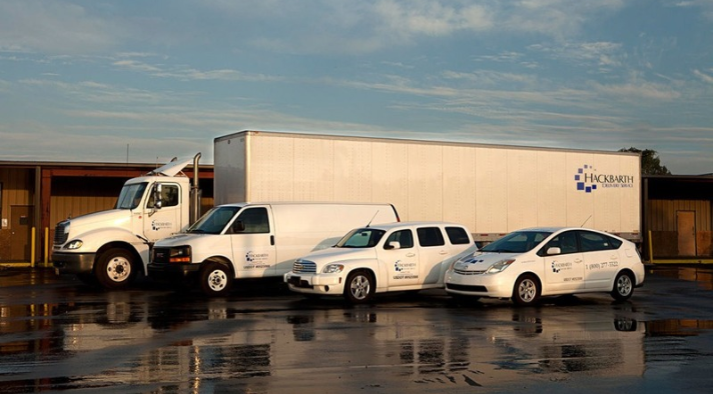
By Christina Rosell Quiroz, Final Mile Solutions & Marketing Manager, Hackbarth Delivery Service
Customers can open an app and rate a delivery in seconds. Transportation providers are quickly realizing that the only acceptable rating is five stars. Everything else fails. The end consumer at the door, phone in hand, has more influence over service-level performance than ever.
Technology has made this the norm. Shippers use near real-time consumer feedback and photo proof of delivery to their advantage. Over a quarter of American households with established internet service use cameras for home surveillance (Parks Associates, 2025), so doorbell cameras are capturing the final steps of final mile transport.
The voice of the customer is the shipper’s measuring stick. Through direct feedback, photo-documented proof of work, and a sharper focus on the end consumer, reliability is being redefined as more than an on-time scan. It now means delivering an experience the customer deems worthy of five stars.
So, what is five-star service? It depends on who you ask.
One thing is certain: you’d better be asking. Scott Louy, Operations Support Manager at Hackbarth Delivery Service, knows this well. He supports a long-standing Hackbarth customer and major appliance retailer whose products require hands-on, high-touch home delivery and installation.
This shipper leverages customer feedback to better gauge performance. Carrier evaluations now include customer surveys as a KPI, and the weight of the customer experience keeps growing.
“A delivery can be on time and completed correctly on paper, but if the customer’s experience falls short, the job cannot be considered a true success,” Scott says.
Proper documentation is now part of the service. Teams must capture photos of the home, product, and services performed on every delivery. Those details help carriers spot issues a delivery status alone may hide. Photos and scans validate the work. Customer feedback determines success.
Scott’s team understands that each survey reflects the customer’s experience with the delivery team on that specific day. “That direct feedback provides an immediate comparison point against the rest of our operational data,” he says. This helps leaders tell whether a low score is a blip or a pattern.
You have to review all the data together. “When a terminal or installer begins trending in the wrong direction, we are not evaluating a single metric,” Scott says. That approach allows for “meaningful conversations focused on root causes rather than simply reacting to a declining score.”
It also streamlines how teams respond, allowing them to take proactive measures. “Missing photos, incomplete documentation, or indicators that installation standards were not met can be identified quickly, allowing us to coach the team and correct behaviors before they become larger operational issues,” he adds.
Data sharing between shippers and carriers benefits both sides. “Operational metrics can tell us what happened, but customer feedback tells us how well we delivered on our promise,” Scott says. The result: more data, more perspectives, and more end consumers tapping five stars on their screens.
For shippers vetting final mile partners, that’s the real test. Technology may track every delivery, but the customer still has the final say.
SOURCE: Parks Associates. (2025, October 28). Parks Associates: 19% of internet households have professionally monitored systems, while 7% pay for non-professional services like alerts and video storage [Press release]. PR Newswire. https://www.prnewswire.com/news-releases/parks-associates-19-of-internet-households-have-professionally-monitored-systems-while-7-pay-for-non-professional-services-like-alerts-and-video-storage-302596302.html
Learn more at www.hackbarthdelivery.com
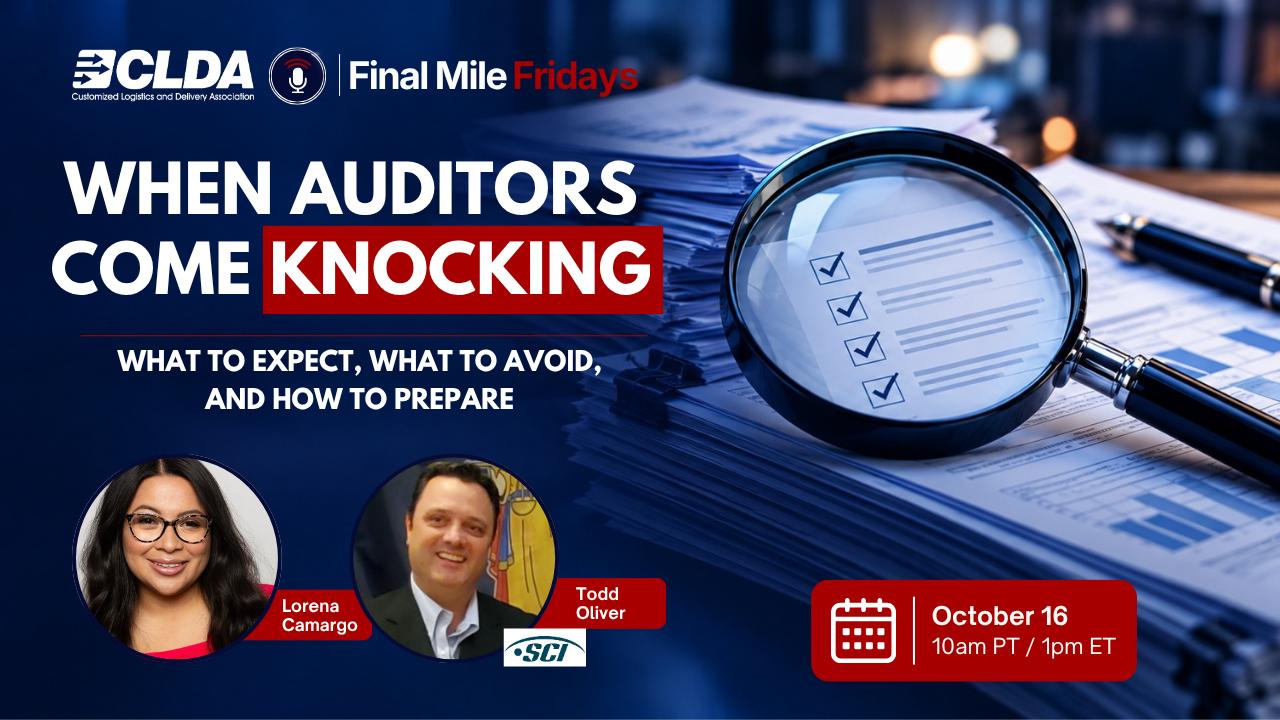
CLDA Final Mile Fridays with Todd Oliver, Director of Government Affairs at SCI
“We’ve always done it this way, and we’ve never had a problem.”
It’s a familiar sentiment among business owners. When processes have worked for years, it’s easy to assume they’ll continue to hold up. But what happens when those practices come under scrutiny?
For final-mile carriers, an audit can raise questions about everything from independent contractor agreements to everyday dispatch practices. And sometimes, the things that seem routine can create unexpected compliance challenges.
During a recent episode of CLDA Final Mile Fridays, CLDA President Lorena Camargo welcomed Todd Oliver, Director of Government Affairs at SCI, for a practical conversation about what triggers audits, what examiners look for, and how carriers can prepare before an issue arises.
The biggest takeaway? Audit readiness isn’t just about having the right paperwork. It’s about how your business actually operates and whether you can demonstrate it.
One common misconception is that audits only happen when a company has done something wrong.
As Oliver explained, that’s not necessarily the case.
Government examinations may come from the IRS, Department of Labor, state unemployment insurance agencies, or workers’ compensation authorities. Businesses may also face scrutiny from insurers, lenders, or legal proceedings.
Some audits are random, but many begin with circumstances such as:
The important question isn’t simply what might trigger an audit, but whether your business is prepared when questions arise.
Having a written independent contractor agreement is important, but auditors don’t stop there.
They examine the actual working relationship, including how delivery opportunities are offered, whether contractors can negotiate pricing, and how much control the carrier exercises over the work.
Oliver emphasized that everyday business records can help demonstrate the independence of those relationships.
That includes delivery contracts, emails, text messages, dispatch records, and documentation showing that contractors operate their own businesses.
What’s written in an agreement should reflect what actually happens in daily operations.
One of the most practical points from the conversation centered on dispatchers and operations managers.
While leadership may understand the distinction between employees and independent contractors, those lines can become blurred in everyday interactions.
Oliver encouraged carriers to train their teams on appropriate terminology and practices. A simple one-page guide can be a useful starting point.
But it’s not just about the words people use. It’s about respecting the independence of the contractor relationship and avoiding unnecessary direction and control over how deliveries are performed.
For companies wondering where to begin, Oliver encouraged a practical approach. Rather than waiting for an audit notice, carriers can start by reviewing their current practices.
Here are five areas worth examining:
The goal isn’t to make compliance unnecessarily complicated. It’s to build processes that support your business and allow you to demonstrate how contractor relationships function.
Oliver’s first piece of advice was simple: Don’t panic.
An audit notice doesn’t automatically mean a company has done something wrong. However, how a carrier responds can make a difference.
He emphasized the importance of working with experienced advisors who understand worker classification and the logistics industry.
Having organized documentation, understanding what information is being requested, and obtaining qualified guidance can help businesses navigate the process.
As Oliver explained, a well-prepared company can demonstrate its business practices rather than scrambling to reconstruct records after an audit begins.
Audit readiness becomes even more important as carriers expand into new markets.
Worker classification requirements and enforcement approaches vary by state, creating additional complexity for businesses operating across multiple jurisdictions.
That’s also why industry advocacy plays such an important role.
During the conversation, Oliver emphasized the importance of having a voice when regulations and enforcement policies affecting final-mile logistics are being developed.
Through its Government Affairs Committee, CLDA works to keep members informed and engaged on issues affecting the industry.
One resource available to CLDA members is the Legislative Tracker, sponsored by SCI, which helps carriers stay informed about proposed legislation and regulatory developments at both the state and federal levels.
For business owners managing daily operations, staying ahead of these changes can make a real difference.
Explore CLDA’s Legislative Tracker →
Staying informed isn’t just about keeping up with legislation. It’s about understanding how potential changes could affect your operations and preparing your business for what’s ahead.
The conversation ended on an encouraging note: strong compliance practices can also support business growth.
Working with established independent businesses, maintaining organized records, and developing consistent operational practices can help strengthen relationships with customers, insurers, and other business partners.
Ultimately, compliance isn’t just about preparing for the possibility of an audit. It’s about building a stronger, more resilient business.
And as Oliver’s insights reinforced, the best time to identify a potential problem isn’t when an auditor is already at your door.
Want to dive deeper? Catch the conversation with Todd Oliver of SCI on CLDA Final Mile Fridays for more insights on audit preparedness, contractor compliance, and protecting your business.
Watch the full episode on YouTube →
To learn more about CLDA and its advocacy resources, visit www.clda.org.
To learn more about SCI, visit www.sciadmin.com.
This article summarizes an educational industry discussion and is not intended as legal advice. Worker classification requirements and audit procedures vary by jurisdiction and circumstances. Carriers should consult qualified advisors regarding their specific obligations.
CLDA Final Mile Fridays with Renee Paul and Alex Dean of SPG Transportation
Growth is usually something to celebrate.
More customers. More drivers. More vehicles. New markets. Bigger opportunities.
But growth has a shadow side that final mile operators don’t always see coming.
Every time your business changes, your risk changes with it.
That was the focus of a recent CLDA Final Mile Fridays conversation featuring Renee Paul, SVP of Last Mile Delivery at Specialty Program Group (SPG Transportation), and Alex Dean. The discussion covered how growth creates new insurance exposures — and why operators who don’t think proactively about coverage can find themselves exposed at exactly the wrong moment.
A company can be growing fast and still be dangerously underinsured. Those two things aren’t mutually exclusive.
Think about the operator who started with 20 trucks under one primary contract. That’s a well-defined, manageable risk profile. Now fast-forward: the same company is running 60 trucks, serving multiple 3PL clients, adding white-glove home delivery and using a mix of W-2 drivers and independent contractors. The revenue has tripled — but the insurance program may still look like it did on day one.
That gap is what Renee calls the “risk shadow” — the space between the company you are today and the coverage you put in place when you were something smaller and simpler. The goal isn’t to slow down growth. It’s to make sure your risk management is keeping pace with it.
One of the most common — and costly — assumptions in this industry is that a coverage limit equals full protection.
Take cargo. An operator looks at the dollar limit on their cargo policy and figures that as long as what they’re hauling is worth less than that number, they’re fine. But commodity type matters. Pharmaceuticals and fine art are examples of cargo that may carry exclusions or require endorsements that a standard policy doesn’t automatically include. Operators moving into new freight categories need to ask the question explicitly — not assume the answer.
Service type matters too. Delivering a package to a doorstep is a different exposure than crossing the threshold into someone’s home to deliver, assemble or install a product. That’s a liability conversation that white-glove operators need to be having with their insurance partners before they sign new contracts — not after a claim surfaces.
Hired and non-owned auto is another area where operators get tripped up. When you’re using independent contractors or vehicles you don’t own, there’s a gap between where the driver’s personal coverage ends and where your company’s exposure begins. Understanding that line — and making sure it’s covered — is critical.
And then there’s contractor compliance — an area Renee is direct about: collecting a certificate of insurance at onboarding is table stakes. The real question is whether that coverage is still in force six months later. Companies that don’t have a process to monitor ongoing compliance are carrying exposure they may not even know about.
Before you take on unfamiliar freight or a new service type, ask: does our current program actually cover what we’re about to do?
Growth doesn’t follow your renewal calendar. You might land your largest customer in June, add vehicles in August and launch a new service in October. Renewal isn’t until February. That’s a long time to operate with a program that no longer fits.
Any of the following should trigger a conversation with your insurance partner — before you move forward, not after:
And if you’re negotiating a new contract, send the insurance requirements to your broker before you sign. They can identify gaps, flag requirements that need to be addressed and sometimes help you push back on terms that go further than the exposure warrants.
The goal is to make that call before you’re committed — not after.
One of the most valuable reframes in the conversation came from Alex: the operators who build the best long-term insurance outcomes aren’t the ones laser-focused on cutting premium. They’re the ones asking a different question.
Instead of: “How do I lower my insurance cost?”
Ask: “How do I improve my risk profile?”
That question opens a very different conversation — one that might include cameras and telematics, MVR monitoring, driver qualification standards, certificate-of-insurance compliance programs and other operational practices that make a company genuinely less risky to insure. Better risk profiles attract better terms. The premium follows.
Your insurance partner should be doing more than processing renewals. They should understand your operation, know where it’s headed and be at the table when you’re evaluating major changes. Think of them the way you’d think of outside legal counsel — someone you bring in before you sign, not after something goes wrong.
Winning customers, adding capacity, entering new markets — that’s the work. Nobody should slow that down.
But the company you’re running today may look very different from the one that signed your current insurance program. And that gap — that risk shadow — is where exposure lives.
So ask yourself honestly: does the insurance program you have today actually match the company you’ve become?
If the answer isn’t a confident yes, it’s time to have that conversation.
Renee Paul and Alex Dean covered a lot of ground in this Final Mile Fridays episode — hidden cargo exposures, hired and non-owned auto, contractor compliance, risk profiling and more. Watch the full conversation on YouTube and see how these issues might apply to your operation.
Watch the full conversation on YouTube →
Have questions about your program? Connect with Renee, Alex and the SPG Transportation team at spgtransportation.com.
The information shared in this article and the accompanying Final Mile Fridays conversation is intended for general educational purposes and should not be considered legal or insurance advice. Companies should consult with their own insurance, legal and risk-management professionals regarding their specific operations.
By Ruth C Correa, Chief Executive Officer, Cheetah Final Mile LLCc
I’ve had the opportunity to experience firsthand how much our industry depends on strong relationships, collaboration, and a willingness to learn from one another. Those same values are a big part of why my involvement with the Customized Logistics and Delivery Association (CLDA) has been so meaningful to me.
One of the highlights of the past Final Mile Forum was helping bring women across the logistics industry together for our Women in Logistics Brunch. What started as an opportunity to connect became a space for meaningful conversations about leadership, growth, challenges, and the experiences we share as women working in logistics and final mile.
The response was incredible, and I’m excited that we’ll be bringing the experience back for the 2nd Annual Women in Logistics Brunch at the Final Mile Forum in Orlando in February 2027. My hope is that we continue building on what we started—creating an environment where women can connect, learn from one another, develop stronger professional relationships, and encourage the next generation of women leaders in our industry.
My involvement with CLDA has also given me the opportunity to serve our members and contribute to an association that continues to move our industry forward. As I come up for reelection to the CLDA Board of Directors, I’m grateful for the opportunity I’ve had to serve and look forward to the possibility of continuing that service, supporting our members, and helping create initiatives that strengthen our CLDA community.
I’m especially excited about what lies ahead at the 2027 Final Mile Forum and hope to see many familiar—and new—faces at the Women in Logistics Brunch.
Outside of my CLDA involvement, my team at Cheetah Final Mile, LLC continues to support customers through customized logistics solutions, including warehousing, cross-docking, specialized home delivery, medical freight, and final-mile services.
I look forward to continuing to connect, collaborate, and grow alongside my fellow CLDA members.
By David Douglas, CEO, Adlinc
For years, logistics companies built their operations around a relatively straightforward model: hire locally, train internally and add people as volume increased.
That model is becoming harder to sustain.
Final-mile operators are navigating rising customer expectations, tighter margins, recruiting challenges, technology changes and increasingly complex service requirements. At the same time, leaders are being asked to improve service without allowing overhead to grow at the same pace.
It raises an important question:
How do we build enough operational capacity to support the business without simply continuing to add overhead?
The answer may require us to rethink what an operations team looks like.
The Workforce Model Is Changing
The traditional conversation around external operational support focused heavily on cost. That conversation is evolving.
Companies are increasingly looking beyond their local hiring markets not simply to reduce labor expenses, but to gain access to talent, operational capacity, specialized skills and greater workforce flexibility.
For logistics companies, this can apply to functions such as dispatch and scheduling, track and trace, customer communication, exception management, order intake, POD management, billing documentation, data entry, recruiting and compliance administration.
These may happen behind the scenes, but they are not insignificant tasks. In many cases, they directly influence whether a shipment moves efficiently, whether an exception is resolved quickly and whether a customer receives the level of communication they expect.
Rather than asking, “What can we outsource?”, logistics leaders may benefit from asking a different question:
“Where should each part of our operation live?”
Not every function belongs outside the organization. But not every function necessarily needs to be performed by a locally hired employee either.
The opportunity is to determine which responsibilities require senior-level judgment or local market knowledge, which depend on real-time communication, and which repetitive but critical functions may be pulling employees away from customers, drivers, sales or higher-level decision-making.
This shifts workforce planning away from replacing people and toward designing the right operating structure.
Nearshore Support Creates Another Option
Historically, companies considering external support often looked toward large offshore markets located thousands of miles and multiple time zones away.
Nearshore markets offer another option.
For North American logistics companies, teams located throughout the Caribbean and Latin America can provide access to skilled professionals while operating within or close to U.S. business hours.
That alignment can be particularly valuable in logistics.
An exception that occurs at 2 p.m. needs attention at 2 p.m. A customer requesting an ETA expects an answer during their workday. A dispatcher managing a changing route needs support in real time.
When external professionals work alongside an internal operation during the same business day, the model can become less about handing work off and more about extending the existing team.
Jamaica is one market participating in this evolution. Its English-speaking workforce, proximity to the United States and cultural familiarity with North American business make it well positioned for operational and professional support.
However, location alone does not determine success. Training, supervision, technology, security, documented processes and industry knowledge remain critical.
Technology Is Changing the Work
Artificial intelligence and automation are also changing how operational teams are structured.
Technology can organize information, accelerate repetitive processes, identify patterns and flag potential problems. People are still needed to interpret exceptions, communicate with customers and drivers, verify information and make judgment calls.
A system may identify that a delivery is running late. Someone may still need to determine why, communicate with the appropriate parties, document the exception and help move the shipment toward resolution.
The operations team of the future will likely combine people, processes and technology, with each performing the work it is best suited to handle.
Industry Knowledge Will Matter More
As external workforce models mature, specialization will become increasingly important.
Logistics companies should expect more than access to available labor. The people supporting their operations need to understand the environment in which they are working.
A professional supporting a final-mile operation should understand that an ETA is more than a field in a system. They should understand routes, drivers, service levels, exceptions, PODs, customer expectations and the urgency that comes with a live delivery operation.
The strongest support models begin with training and operational understanding, not simply filling a seat.
Start With the Work, Not the Headcount
When evaluating workforce strategy, logistics leaders may benefit from starting with an operational assessment rather than deciding how many people they need.
Where are the bottlenecks? What work consistently falls behind? Which responsibilities pull managers away from higher-value activities? Where is overtime increasing? Which functions are difficult to cover during evenings, weekends, holidays or periods of increased volume?
And perhaps most importantly:
Where are customers or drivers waiting because the internal team simply does not have enough capacity?
The answer will not always be external support.
Sometimes the right solution is another local hire. Sometimes it is better technology. Sometimes it is a process change. And sometimes it makes sense to extend the internal team through specialized nearshore operational support.
For many organizations, the strongest model may ultimately include a combination of all four.
Build Flexibility Before You Need It
Operational capacity is difficult to build overnight.
A new customer comes onboard. Volume increases unexpectedly. A key employee leaves. Seasonal demand arrives faster than expected.
These moments often reveal weaknesses in a workforce model that were already there.
The better time to identify those vulnerabilities is before they become emergencies.
As we look toward 2027 and beyond, I believe successful logistics companies will increasingly separate the question of where someone works from the more important question of how effectively the work gets done.
The operations team of the future may span multiple locations. It may combine internal employees, specialized nearshore professionals and increasingly sophisticated technology.
But to the customer, none of that should matter.
They should simply experience a responsive, reliable operation that communicates well and delivers consistently.
That is ultimately the workforce strategy that matters most.
About the Author
David Douglas is the Chief Executive Officer of Adlinc Business Services. With decades of experience supporting transportation and logistics organizations across North America, he is passionate about helping businesses strengthen operations, improve efficiency, and build resilient teams that support long term growth.
Learn more at www.adlinc.com
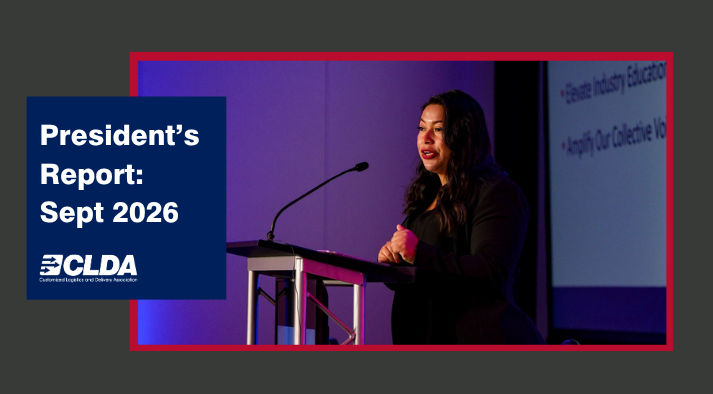
Fall is officially here, but things are heating up here at CLDA. In a little over a week we will be in Scottsdale Arizona for the next installment of our in-person regional networking series – CONNECT AZ. Join CLDA and Openforce on October 8, 2026 as we take over Sophia’s Kitchen for a great night of networking and education.
A little over two weeks ago we officially launched registration for the 2027 Final Mile Forum (FMF27) which will be held February 10-12 at the Hilton Orlando Lake Buena Vista in Orlando, FL. We’ve lowered the price of registration since last year and come up with an extra special offer that’s almost too good to be true. Join CLDA or renew your membership and register for FMF27 by November 30,2026 and save a total of $700 off of the non-member price.
Our staff has been hard at work alongside the FMF27 Committee, Education Committee, Marketing Committee and Shipper Task Force to make this year’s event something truly special.
2027 marks CLDA’s 40th anniversary, and we’re building a Final Mile Forum worthy of the occasion. FMF27 will bring together the people, ideas and opportunities that move the final-mile industry forward, with an expanded lineup of education, new structured networking experiences and more ways to connect with the partners who can help grow your business. From entering new markets and verticals to building stronger relationships with carriers, shippers and industry partners, this year’s Forum is being designed around creating real opportunities for our members.
For our Affiliate members, sponsors and industry partners, we’re also rethinking what sponsorship can look like. New year-round partnerships, event packages and standalone opportunities give your company more ways to stay visible, engage directly with attendees and put your brand at the center of the FMF27 experience. Go beyond a logo on a sign. Put your brand behind one of our signature pre-conference events, like the high-energy Fastest Courier Challenge or our second annual Women in Logistics Brunch. Create a destination attendees will seek out with experiences like the Paws & Relax Puppy Lounge or the Final Mile Rest Stop Massage Lounge. These opportunities are designed to create interaction, generate conversation and give attendees a reason to remember who made the experience possible.
With new programming, new ways to connect and plenty of surprises planned for our 40th anniversary, FMF27 is shaping up to be a Final Mile Forum you won’t want to miss.
Michael Wright
CLDA Executive Director
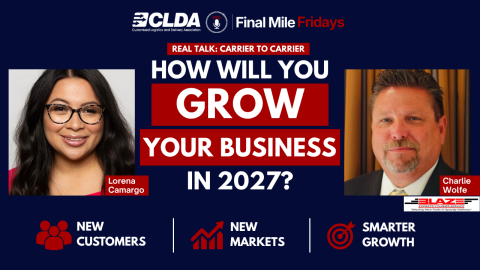
CLDA Final Mile Fridays with Charlie Wolfe, Blaze Logistics
Growth is usually one of the first goals on a carrier’s business plan.
More customers. More routes. More markets. More revenue.
But sustainable growth requires a more important question:
Is this growth actually making the business stronger?
For final mile carriers planning for 2027, growth shouldn’t be measured by revenue alone. Profitability, operational capacity, customer concentration, service capabilities and long-term opportunity all matter.
Here are six areas carriers should consider when building a growth strategy.
Top-line revenue is an easy way to measure growth, but it doesn’t tell the whole story.
A carrier can add significant revenue while simultaneously reducing profitability.
New business often requires investment. A large account might require additional drivers, management, technology, equipment or operational support. Expanding into a new market can create overhead before enough volume exists to support it.
That doesn’t necessarily make it a bad opportunity.
Lower profitability in the short term may create something valuable in the long term, including greater route density, economies of scale, entry into a new vertical or infrastructure that can support additional customers.
The important question is why profitability is declining and what needs to happen for that investment to pay off.
A growing top line may look impressive, but sustainable growth eventually needs to reach the bottom line.
The goal isn’t simply more revenue. It’s a healthier business.
Growth doesn’t always require finding a brand-new customer.
Existing customers can be one of the most overlooked sources of new business.
A customer using a carrier for on-demand deliveries may also have scheduled routes. A company using a carrier in one market may have needs in another. A freight forwarder or 3PL may have additional customers, lanes or services that fit the carrier’s operation.
Carriers should regularly ask:
There is also a major advantage to expanding an existing relationship: trust already exists.
The customer knows the carrier’s performance and capabilities, while the carrier already understands the customer’s expectations.
That can make expansion within an existing account easier than starting from zero with a new prospect.
But it shouldn’t replace new-customer acquisition entirely.
A healthy growth strategy needs both: deeper relationships with existing customers and a consistent pipeline of new ones.
One of the hardest disciplines in a growing transportation company is knowing when to say no.
Once a carrier proves itself, customers may begin asking it to handle additional services. That can create tremendous opportunity, but it can also create risk.
Before saying yes, carriers should ask:
Sometimes saying yes to a service outside the company’s strengths can do more damage than saying no.
The same applies to pricing.
A large opportunity can be tempting enough that a carrier accepts margins it normally wouldn’t. But a big piece of unprofitable business is still unprofitable business.
Sometimes the better decision is to negotiate, restructure the opportunity or walk away.
Not all revenue is good revenue.
Consider a simple scenario.
A carrier has the choice between:
One customer generating $1 million annually
or
Ten customers generating $100,000 each.
Assume the total revenue and profitability are approximately the same.
One large customer may offer operational efficiencies and significant density, but it also creates concentration risk.
Customers leave. Contracts change. Companies experience financial difficulties. Leadership changes. Another provider may win the account. And sometimes business disappears for reasons completely outside the carrier’s control.
With ten customers, losing one represents 10% of that revenue.
With one customer, losing the account represents 100%.
That doesn’t mean carriers should avoid large opportunities. Large customers can be transformational.
It means concentration should be evaluated alongside revenue.
Before pursuing a major account, consider:
The bigger the opportunity, the more important the risk assessment becomes.
Winning business and successfully absorbing business are two different things.
An opportunity can look profitable on paper and become very different once operations begin.
The account may require more management than anticipated. Driver requirements may be more complicated. Routes may take longer than expected. Customer-specific SOPs, technology or compliance requirements may add unexpected costs.
That’s why growth planning can’t belong exclusively to sales.
Operations needs to be part of the conversation.
Before taking on significant new business, carriers should understand their:
There is also a timing challenge.
Carriers can’t wait until every new account is signed before investing in infrastructure, but they also can’t continually build capacity for revenue that may never materialize.
The goal is to create enough scalable infrastructure to absorb growth without overbuilding ahead of it.
Winning the account is only the first step. The operation has to be able to deliver on what sales promised.
New opportunities don’t necessarily require reinventing the business.
Sometimes the best opportunities are adjacent to capabilities a carrier already has.
Healthcare and life sciences are one example. Direct-to-patient shipments, gene therapy and other specialized healthcare transportation needs can create opportunities for carriers with the right processes, training and partnerships.
But every market is different.
For another carrier, the opportunity might be dedicated fleets, distribution, freight-forwarder partnerships, routed work or taking over transportation that a local company currently manages internally.
Instead of simply asking, “What’s the next hot vertical?” consider a different question:
What are we already good at, and where else is that capability valuable?
Look at industries using similar service models, additional needs within existing customers, services that complement current routes, new geographic markets and partnerships that can extend your reach.
Growth doesn’t always require a completely new direction.
Sometimes it means finding more places where your existing strengths solve a problem.
Sustainable growth isn’t about saying yes to every opportunity. It’s about knowing your margins, your capacity, your strengths and the level of risk you’re willing to take.
As carriers plan for 2027, instead of simply asking:
“How much do we want to grow?”
Consider asking:
These were some of the questions I explored with Charlie Wolfe of Blaze Logistics during our recent CLDA Final Mile Fridays conversation.
That’s one of the things I value most about the CLDA community. We may compete for business, but we can still compare experiences, learn from one another and help each other build stronger businesses.
Want to hear the full conversation?
▶ Watch CLDA Final Mile Fridays on YouTube
Or better yet, join the conversation in person.
Join us February 10–12 in Orlando for the CLDA Final Mile Forum, where carriers and industry leaders from across the country will come together to share ideas, build relationships and learn from one another.
Because we may compete for business, but we can still help each other build better businesses.
Join us at the CLDA Final Mile Forum
CLDA Final Mile Fridays brings together industry leaders and experts for practical conversations about the issues affecting final mile businesses. Follow CLDA for upcoming episodes and conversations designed to help move the final mile industry forward.
The information shared in this article and the accompanying Final Mile Fridays conversation is intended for general educational purposes and should not be considered legal or insurance advice. Companies should consult with their own insurance, legal and risk-management professionals regarding their specific operations.
Are you joining us in Orlando?
Final Mile Forum 2027 will be here before we know it, and I’m hoping to see as many of our CLDA members there as possible.
And right now, CLDA members have a great opportunity to make plans early and save. Members who renew their CLDA membership and register for FMF by November 30 can take advantage of a special $995 registration rate.
As we prepare for Orlando, I’ve been thinking a lot about the conversations we need to be having as an industry.
Running a final mile business has never been simple. But lately, the questions we’re asking as business owners have changed.
It’s no longer just: How do we get more business?
It’s: Are we ready for the business when it comes? Are our margins where they need to be? Are we managing risk as we grow? Are we keeping up with compliance? Are we using our data to make better decisions?
These are questions I’m thinking about in my own business, and I know from conversations with many of you that I’m not alone.
That’s one of the things I’ve enjoyed most about CLDA Final Mile Fridays. These conversations have given us an opportunity to hear different perspectives, ask better questions and learn from one another about the issues affecting our businesses.
And that’s exactly what I’m looking forward to continuing at Final Mile Forum 2027 in Orlando.
As valuable as our virtual connections are, there’s still nothing quite like bringing the CLDA community together in person. FMF is our opportunity to learn from one another, build new relationships, reconnect with longtime friends and have conversations that can help us build stronger businesses and a stronger industry.
So if Orlando is on your calendar, renew your CLDA membership and register for FMF by November 30 to lock in the special $995 member rate.
I’m looking forward to seeing you there.
See you in Orlando!
Lorena Camargo
CLDA President
Learn more and get involved with CLDA today!
CLDA Final Mile Fridays with Lauren King, CXT Software
For experienced final mile carriers, healthcare logistics can look like a natural opportunity for growth.
You already know how to manage time-sensitive deliveries. You have drivers, dispatchers, technology and operational processes in place. How different can delivering for a healthcare customer really be?
The difference is what’s at stake when something goes wrong.
A missed retail delivery may result in an unhappy customer and a redelivery. A missed medical delivery could delay medication, compromise a specimen or potentially affect a patient’s care.
That changes what healthcare organizations expect from their transportation partners.
On a recent episode of CLDA Final Mile Fridays, Lauren King of CXT Software joined us to discuss what it takes to build a healthcare-ready courier operation and why carriers shouldn’t look at compliance simply as another requirement to satisfy.
Here are some of the biggest takeaways.
Healthcare customers aren’t simply hiring a company to move something from Point A to Point B.
They may be entrusting a carrier with medications, specimens, vaccines, medical devices, temperature-sensitive materials or other critical shipments.
If something goes wrong, the consequences can extend far beyond a service failure.
A patient could be waiting at home for medication that needs to be administered by a nurse. A specimen may need to reach a laboratory within a specific timeframe. A temperature excursion could compromise a shipment.
That responsibility changes the relationship between the healthcare organization and its courier.
King explained that healthcare organizations often view their transportation providers as an extension of their own brand and service commitment. They want confidence that the carrier representing them can consistently execute according to their standards.
In healthcare logistics, you’re not just delivering a package. You’re becoming part of the healthcare organization’s operation.
Anyone who has responded to a healthcare RFP knows the questions can be extensive.
Chain of custody. Information security. Training. Documentation. Quality processes. Incident response. Driver qualifications. Insurance. Technology.
Why do healthcare organizations need to know so much about a transportation provider?
Because each of those areas can become a point where a logistics failure creates a larger regulatory, legal, financial or patient safety risk.
Ultimately, King said much of what healthcare organizations are trying to determine comes down to one thing: predictability.
Can they trust the carrier to follow the same processes on its worst day that it follows on its best?
No transportation operation is perfect. Traffic happens. Vehicles break down. Drivers make mistakes. Deliveries can be delayed.
Healthcare organizations know that.
What they want to understand is what happens next.
Do you have an escalation process? Is the customer notified? Is there a backup driver? Can you document what happened? Can your operation respond consistently when something doesn’t go according to plan?
The goal isn’t to convince a healthcare customer that nothing will ever go wrong. It’s to show them you’re prepared when something does.
One of King’s strongest pieces of advice for carriers was to change the way they think about compliance.
Too often, compliance is treated defensively.
Have the right policies so you can pass an audit. Maintain the required certifications. Avoid a finding. Check the boxes on the RFP.
King suggested carriers take a different approach:
“Don’t use compliance as defense. Use it as offense.”
Instead of waiting for a prospective customer to ask about your compliance program, make it part of your value proposition.
Show them how you qualify drivers. Explain how you protect chain of custody. Demonstrate how exceptions are documented and escalated. Show how your technology helps ensure that the right driver is assigned to the right delivery.
Having policies isn’t enough.
Healthcare customers increasingly want evidence that those policies are actually embedded in the operation.
Compliance shouldn’t simply help you keep healthcare business. Done well, it can help you win it.
It’s easier than ever to create policies and procedures.
But having a document that says what should happen isn’t the same as having an operation that makes sure it happens.
That’s where technology becomes especially important.
Consider driver qualifications.
A driver who is qualified to deliver tires isn’t automatically qualified to transport every type of healthcare shipment. Depending on the work, a driver may need specific training, certifications or customer-required credentials.
Technology can help match those qualifications to individual jobs and prevent assignments from going to drivers who don’t meet the necessary requirements.
It can also create a system of record.
When a healthcare customer conducts an audit and asks for driver certifications, proof of delivery, chain-of-custody information or other documentation, the carrier should be able to retrieve that information quickly.
A policy establishes the standard. Technology can help enforce it and prove that it was followed.
Healthcare logistics isn’t limited to the largest transportation companies.
Regional and smaller carriers can compete, but the time to prepare isn’t when a healthcare RFP suddenly lands in your inbox.
King encouraged carriers interested in the space to start doing the work now.
Learn the compliance requirements. Review your policies and procedures. Understand what training and certifications may be required. Talk with your insurance broker about the commodities you plan to transport. Evaluate whether your technology can support the necessary operational controls and documentation.
Insurance is particularly important because “medical logistics” covers a wide range of transportation.
Specimens, medications, medical devices, organs, radiopharmaceuticals and temperature-sensitive materials can each introduce different requirements and risks.
A carrier shouldn’t assume that having a transportation insurance policy means every type of healthcare shipment is automatically covered.
The more specialized the opportunity becomes, the more important it is to understand exactly what you’re agreeing to transport and what additional requirements may apply.
Prepare before the opportunity arrives so you’re ready when it does.
Carriers interested in healthcare logistics don’t have to figure everything out on their own.
King encouraged operators to talk with other carriers already working in the space, technology providers, insurance professionals and other industry resources.
The CLDA community can be especially valuable here.
A carrier in California, for example, may be able to call another CLDA member in Florida or New York who isn’t a direct competitor but has experience with the same type of healthcare delivery.
Ask what they’ve learned. What surprised them? What did healthcare customers require? What would they put in place differently if they were starting today?
Those conversations don’t replace your own research or professional guidance, but they can help you identify questions you may not have known to ask.
Don’t wait until you win healthcare business to start learning how healthcare logistics works.
Healthcare logistics technology is also continuing to evolve.
Over the next several years, King expects healthcare organizations to want greater connectivity between systems and more real-time information from transportation partners.
Temperature-controlled transportation is one example.
Instead of discovering after a delivery that a shipment experienced a temperature excursion, connected sensors could provide real-time information showing that a shipment is trending toward an unacceptable temperature.
That gives the carrier an opportunity to act before the shipment is compromised.
The same idea could apply to proof of delivery.
Rather than discovering during an audit that a driver submitted an unusable photo, technology using computer vision could potentially recognize the problem when the photo is taken and ask the driver to capture another image.
The distinction is important.
The next generation of healthcare logistics technology won’t simply document what went wrong. It will increasingly help carriers prevent something from going wrong in the first place.
Healthcare logistics can be an attractive growth opportunity for final mile carriers, but entering the market requires more than adding “medical courier” to a capabilities sheet.
Healthcare organizations are looking for transportation partners they can trust with high-stakes deliveries.
That means carriers need the right processes, training, technology, insurance, documentation and contingency plans already in place.
Start learning before the RFP arrives. Talk to carriers already doing the work. Understand the requirements. Evaluate your technology. Review your insurance. Build the operational controls.
And when you’re ready to pursue the business, don’t hide all of that preparation behind the scenes.
Make it part of the reason the customer should choose you.
Don’t just tell healthcare customers you’re compliant. Show them why your operation can be trusted.
To learn more about CXT Software, please visit cxtsoftware.com.
Watch the full CLDA Final Mile Fridays conversation with Lauren King of CXT Software for more on healthcare logistics, compliance, technology, driver qualifications, preparing for healthcare opportunities and what’s coming next for medical courier operations.
Watch full conversation on YouTube.
CLDA Final Mile Fridays brings together industry leaders and experts for practical conversations about the issues affecting final mile businesses. Follow CLDA for upcoming episodes and conversations designed to help move the final mile industry forward.
The information shared in this article and the accompanying Final Mile Fridays conversation is intended for general educational purposes and should not be considered legal or insurance advice. Companies should consult with their own insurance, legal and risk-management professionals regarding their specific operations.