





CLDA Members are encouraged to share news about their company. CLDA may share on social media, in newsletters or the Customized Logistics & Delivery Magazine.

Ready to share your news with CLDA or the industry media? Learn from these tips and tricks on how to get noticed.

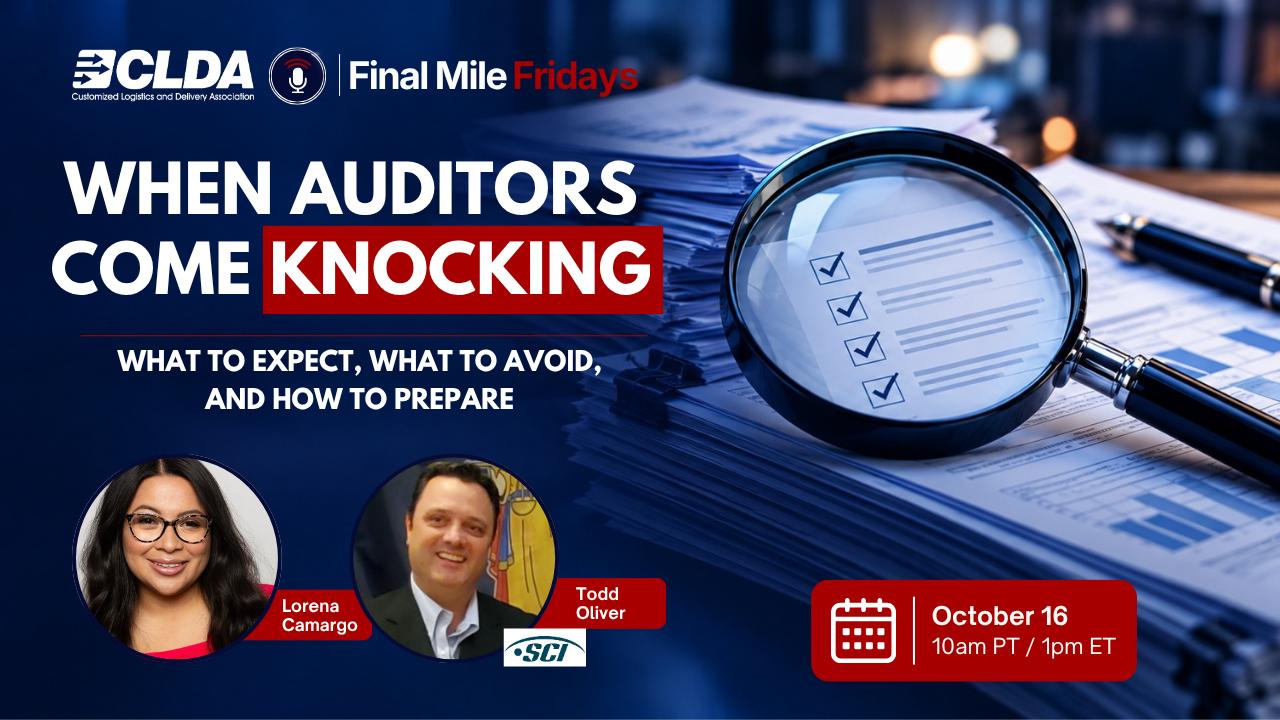
CLDA Final Mile Fridays with Renee Paul and Alex Dean of SPG Transportation
Growth is usually something to celebrate.
More customers. More drivers. More vehicles. New markets. Bigger opportunities.
But growth has a shadow side that final mile operators don’t always see coming.
Every time your business changes, your risk changes with it.
That was the focus of a recent CLDA Final Mile Fridays conversation featuring Renee Paul, SVP of Last Mile Delivery at Specialty Program Group (SPG Transportation), and Alex Dean. The discussion covered how growth creates new insurance exposures — and why operators who don’t think proactively about coverage can find themselves exposed at exactly the wrong moment.
A company can be growing fast and still be dangerously underinsured. Those two things aren’t mutually exclusive.
Think about the operator who started with 20 trucks under one primary contract. That’s a well-defined, manageable risk profile. Now fast-forward: the same company is running 60 trucks, serving multiple 3PL clients, adding white-glove home delivery and using a mix of W-2 drivers and independent contractors. The revenue has tripled — but the insurance program may still look like it did on day one.
That gap is what Renee calls the “risk shadow” — the space between the company you are today and the coverage you put in place when you were something smaller and simpler. The goal isn’t to slow down growth. It’s to make sure your risk management is keeping pace with it.
One of the most common — and costly — assumptions in this industry is that a coverage limit equals full protection.
Take cargo. An operator looks at the dollar limit on their cargo policy and figures that as long as what they’re hauling is worth less than that number, they’re fine. But commodity type matters. Pharmaceuticals and fine art are examples of cargo that may carry exclusions or require endorsements that a standard policy doesn’t automatically include. Operators moving into new freight categories need to ask the question explicitly — not assume the answer.
Service type matters too. Delivering a package to a doorstep is a different exposure than crossing the threshold into someone’s home to deliver, assemble or install a product. That’s a liability conversation that white-glove operators need to be having with their insurance partners before they sign new contracts — not after a claim surfaces.
Hired and non-owned auto is another area where operators get tripped up. When you’re using independent contractors or vehicles you don’t own, there’s a gap between where the driver’s personal coverage ends and where your company’s exposure begins. Understanding that line — and making sure it’s covered — is critical.
And then there’s contractor compliance — an area Renee is direct about: collecting a certificate of insurance at onboarding is table stakes. The real question is whether that coverage is still in force six months later. Companies that don’t have a process to monitor ongoing compliance are carrying exposure they may not even know about.
Before you take on unfamiliar freight or a new service type, ask: does our current program actually cover what we’re about to do?
Growth doesn’t follow your renewal calendar. You might land your largest customer in June, add vehicles in August and launch a new service in October. Renewal isn’t until February. That’s a long time to operate with a program that no longer fits.
Any of the following should trigger a conversation with your insurance partner — before you move forward, not after:
And if you’re negotiating a new contract, send the insurance requirements to your broker before you sign. They can identify gaps, flag requirements that need to be addressed and sometimes help you push back on terms that go further than the exposure warrants.
The goal is to make that call before you’re committed — not after.
One of the most valuable reframes in the conversation came from Alex: the operators who build the best long-term insurance outcomes aren’t the ones laser-focused on cutting premium. They’re the ones asking a different question.
Instead of: “How do I lower my insurance cost?”
Ask: “How do I improve my risk profile?”
That question opens a very different conversation — one that might include cameras and telematics, MVR monitoring, driver qualification standards, certificate-of-insurance compliance programs and other operational practices that make a company genuinely less risky to insure. Better risk profiles attract better terms. The premium follows.
Your insurance partner should be doing more than processing renewals. They should understand your operation, know where it’s headed and be at the table when you’re evaluating major changes. Think of them the way you’d think of outside legal counsel — someone you bring in before you sign, not after something goes wrong.
Winning customers, adding capacity, entering new markets — that’s the work. Nobody should slow that down.
But the company you’re running today may look very different from the one that signed your current insurance program. And that gap — that risk shadow — is where exposure lives.
So ask yourself honestly: does the insurance program you have today actually match the company you’ve become?
If the answer isn’t a confident yes, it’s time to have that conversation.
Renee Paul and Alex Dean covered a lot of ground in this Final Mile Fridays episode — hidden cargo exposures, hired and non-owned auto, contractor compliance, risk profiling and more. Watch the full conversation on YouTube and see how these issues might apply to your operation.
Watch the full conversation on YouTube →
Have questions about your program? Connect with Renee, Alex and the SPG Transportation team at spgtransportation.com.
The information shared in this article and the accompanying Final Mile Fridays conversation is intended for general educational purposes and should not be considered legal or insurance advice. Companies should consult with their own insurance, legal and risk-management professionals regarding their specific operations.
Two recent U.S. Supreme Court decisions may affect freight brokers, final-mile delivery companies, motor carriers, and businesses that use independent contractors.
The first decision increases potential liability for companies that select outside carriers. The second may make some arbitration agreements with local drivers harder to enforce under federal law.
These rulings do not create automatic liability or eliminate arbitration, but they do require members to review their current practices.
What Happened
C.H. Robinson selected Caribe Transport to move a shipment. After a serious accident, the injured driver claimed the broker should not have selected Caribe because of concerns about its safety record.
Lower courts dismissed the claim under the Federal Aviation Administration Authorization Act, or FAAAA. On May 14, 2026, the Supreme Court reversed that decision.
What the Court Decided
The Court ruled that the FAAAA does not automatically block a state-law negligent-selection claim against a freight broker when motor-vehicle safety is involved.
The Court did not find C.H. Robinson negligent. It simply allowed the case to continue so a lower court can decide whether the broker acted reasonably.
Why This Matters
Members that broker, subcontract, or assign work to outside carriers may face greater scrutiny after an accident.
A court may examine:
The insurance impact is still developing, but members should expect closer review of brokerage practices and coverage.
What Members Should Do
Strengthen carrier vetting. Review operating authority, insurance, safety ratings, out-of-service data, crash history, and other warning signs.
Document each decision. Keep records showing what was reviewed, who approved the carrier, and why.
Use the same process every time. Do not skip vetting because a shipment is urgent or capacity is limited.
Monitor approved carriers. Recheck authority, insurance, and safety information regularly.
Review contracts and insurance. Ask counsel and insurance professionals whether current agreements and policies address negligent selection, broker liability, contingent auto exposure, Sand defense costs.
Train staff. Anyone selecting or dispatching outside carriers should understand the company’s process.
More information:
What Happened
A Colorado distributor delivered Flowers Foods products only within Colorado, but the products had originally come from outside the state.
When the distributor brought wage-related claims, Flowers Foods tried to require arbitration under the Federal Arbitration Act, or FAA.
On May 28, 2026, the Supreme Court ruled that a local driver may still qualify for the FAA’s transportation-worker exemption even if the driver never crosses state lines.
What the Court Decided
A worker may be exempt from the FAA when the work is a direct and necessary part of moving goods through interstate commerce.
In simple terms, a local final-mile driver may still be treated as an interstate transportation worker when delivering goods that are continuing an interstate journey.
The ruling does not make all arbitration agreements invalid. It means the FAA may not always be available to enforce them. State arbitration law may still apply, depending on the contract and jurisdiction.
Why This Matters
Many CLDA members use arbitration agreements with drivers, owner-operators, route operators, and independent contractors.
If those agreements rely only on the FAA, companies may have difficulty forcing certain disputes into arbitration. Wage, classification, contract, and other claims may instead proceed in court.
The Court left several questions unanswered, including when an interstate journey ends and how the ruling applies to contracts between two business entities.
What Members Should Do
Review arbitration clauses. Have transportation and employment counsel review agreements with drivers and contractors.
Do not rely only on the FAA. Ask whether the agreement should also rely on applicable state arbitration law.
Add fallback language. Agreements should explain what happens if the FAA does not apply.
Review the real working relationship. Courts will look at what the worker actually does, not just whether the contract calls the person an independent contractor or business owner.
Document how goods move. Keep records showing where goods originate, how long they are stored, whether ownership changes, and where the delivery journey ends.
Review business-to-business arrangements. Contracting with a legitimate LLC or corporation may strengthen the commercial nature of the relationship, but the business must be real and independently operated. An LLC on paper alone is not enough.
Use personal guarantees carefully. These may provide added protection in some business-to-business contracts, but they should be reviewed and drafted by counsel.
More information:
Members should promptly review:
CLDA will continue monitoring these cases and sharing updates as courts and insurers respond.
This communication is for general informational purposes and does not constitute legal, insurance, tax, or employment advice. Members should consult qualified professionals regarding their own operations.
CLDA Advocacy Fund
These decisions are a reminder that legal and regulatory changes can quickly affect how our members operate, manage risk, and protect their businesses. CLDA’s advocacy work helps ensure the final-mile industry has a strong, informed voice with lawmakers, regulators, and the courts.
Your support makes that work possible. Please consider making a contribution to the CLDA Advocacy Fund so we can continue monitoring critical developments, educating members, and advancing policies that support a strong and competitive delivery industry.