By David Douglas, CEO, Adlinc
For years, logistics companies built their operations around a relatively straightforward model: hire locally, train internally and add people as volume increased.
That model is becoming harder to sustain.
Final-mile operators are navigating rising customer expectations, tighter margins, recruiting challenges, technology changes and increasingly complex service requirements. At the same time, leaders are being asked to improve service without allowing overhead to grow at the same pace.
It raises an important question:
How do we build enough operational capacity to support the business without simply continuing to add overhead?
The answer may require us to rethink what an operations team looks like.
The Workforce Model Is Changing
The traditional conversation around external operational support focused heavily on cost. That conversation is evolving.
Companies are increasingly looking beyond their local hiring markets not simply to reduce labor expenses, but to gain access to talent, operational capacity, specialized skills and greater workforce flexibility.
For logistics companies, this can apply to functions such as dispatch and scheduling, track and trace, customer communication, exception management, order intake, POD management, billing documentation, data entry, recruiting and compliance administration.
These may happen behind the scenes, but they are not insignificant tasks. In many cases, they directly influence whether a shipment moves efficiently, whether an exception is resolved quickly and whether a customer receives the level of communication they expect.
Rather than asking, “What can we outsource?”, logistics leaders may benefit from asking a different question:
“Where should each part of our operation live?”
Not every function belongs outside the organization. But not every function necessarily needs to be performed by a locally hired employee either.
The opportunity is to determine which responsibilities require senior-level judgment or local market knowledge, which depend on real-time communication, and which repetitive but critical functions may be pulling employees away from customers, drivers, sales or higher-level decision-making.
This shifts workforce planning away from replacing people and toward designing the right operating structure.
Nearshore Support Creates Another Option
Historically, companies considering external support often looked toward large offshore markets located thousands of miles and multiple time zones away.
Nearshore markets offer another option.
For North American logistics companies, teams located throughout the Caribbean and Latin America can provide access to skilled professionals while operating within or close to U.S. business hours.
That alignment can be particularly valuable in logistics.
An exception that occurs at 2 p.m. needs attention at 2 p.m. A customer requesting an ETA expects an answer during their workday. A dispatcher managing a changing route needs support in real time.
When external professionals work alongside an internal operation during the same business day, the model can become less about handing work off and more about extending the existing team.
Jamaica is one market participating in this evolution. Its English-speaking workforce, proximity to the United States and cultural familiarity with North American business make it well positioned for operational and professional support.
However, location alone does not determine success. Training, supervision, technology, security, documented processes and industry knowledge remain critical.
Technology Is Changing the Work
Artificial intelligence and automation are also changing how operational teams are structured.
Technology can organize information, accelerate repetitive processes, identify patterns and flag potential problems. People are still needed to interpret exceptions, communicate with customers and drivers, verify information and make judgment calls.
A system may identify that a delivery is running late. Someone may still need to determine why, communicate with the appropriate parties, document the exception and help move the shipment toward resolution.
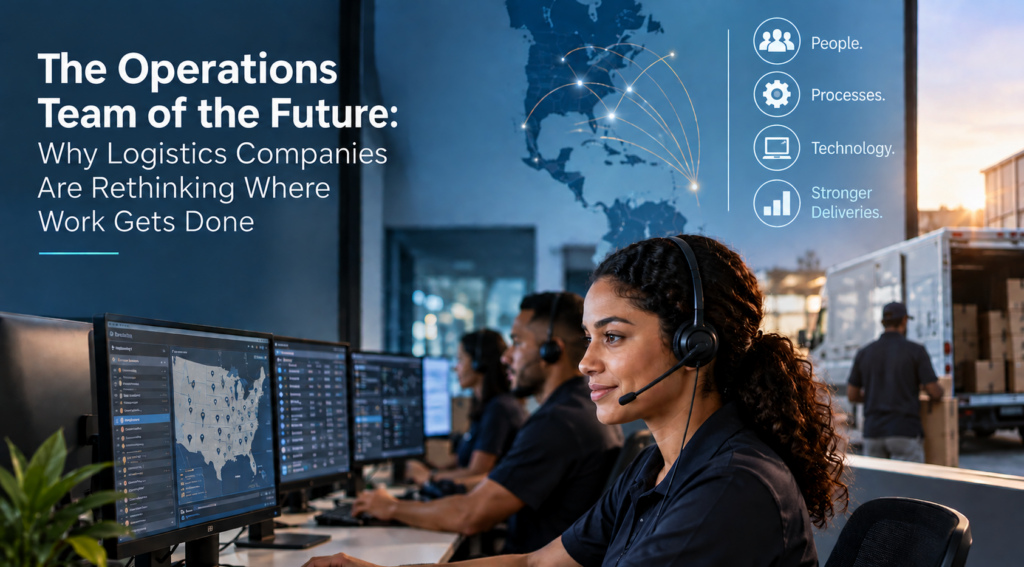
The operations team of the future will likely combine people, processes and technology, with each performing the work it is best suited to handle.
Industry Knowledge Will Matter More
As external workforce models mature, specialization will become increasingly important.
Logistics companies should expect more than access to available labor. The people supporting their operations need to understand the environment in which they are working.
A professional supporting a final-mile operation should understand that an ETA is more than a field in a system. They should understand routes, drivers, service levels, exceptions, PODs, customer expectations and the urgency that comes with a live delivery operation.
The strongest support models begin with training and operational understanding, not simply filling a seat.
Start With the Work, Not the Headcount
When evaluating workforce strategy, logistics leaders may benefit from starting with an operational assessment rather than deciding how many people they need.
Where are the bottlenecks? What work consistently falls behind? Which responsibilities pull managers away from higher-value activities? Where is overtime increasing? Which functions are difficult to cover during evenings, weekends, holidays or periods of increased volume?
And perhaps most importantly:
Where are customers or drivers waiting because the internal team simply does not have enough capacity?
The answer will not always be external support.
Sometimes the right solution is another local hire. Sometimes it is better technology. Sometimes it is a process change. And sometimes it makes sense to extend the internal team through specialized nearshore operational support.
For many organizations, the strongest model may ultimately include a combination of all four.
Build Flexibility Before You Need It
Operational capacity is difficult to build overnight.
A new customer comes onboard. Volume increases unexpectedly. A key employee leaves. Seasonal demand arrives faster than expected.
These moments often reveal weaknesses in a workforce model that were already there.
The better time to identify those vulnerabilities is before they become emergencies.
As we look toward 2027 and beyond, I believe successful logistics companies will increasingly separate the question of where someone works from the more important question of how effectively the work gets done.
The operations team of the future may span multiple locations. It may combine internal employees, specialized nearshore professionals and increasingly sophisticated technology.
But to the customer, none of that should matter.
They should simply experience a responsive, reliable operation that communicates well and delivers consistently.
That is ultimately the workforce strategy that matters most.
About the Author
David Douglas is the Chief Executive Officer of Adlinc Business Services. With decades of experience supporting transportation and logistics organizations across North America, he is passionate about helping businesses strengthen operations, improve efficiency, and build resilient teams that support long term growth.
Learn more at www.adlinc.com