






CLDA Members are encouraged to share news about their company. CLDA may share on social media, in newsletters or the Customized Logistics & Delivery Magazine.

Ready to share your news with CLDA or the industry media? Learn from these tips and tricks on how to get noticed.

Jacqueline Epifanie has built relationships across financial services, energy, aviation, and logistics technology. Along the way, she learned a lesson that still shapes how she approaches a room full of strangers: leave space for a real conversation.
On CLDA’s Final Mile Fridays, the Chief Marketing Officer at Dispatch Science shared an early-career experience when a carefully prepared introduction became too much of a pitch. Honest feedback prompted her to change her approach, and that awkward first meeting eventually developed into a valuable mentoring relationship.
Today, she brings that experience to helping others feel more comfortable, ask thoughtful questions, and build meaningful connections at business events.
Joining her was CLDA President Lorena Camargo, who offered her perspective as a carrier, business owner, and recent exhibitor. Epifanie describes herself as an extrovert; Camargo identifies as an introvert. Their conversation showed how different personalities can find their own ways to connect.
Whether you’re preparing for CLDA’s Final Mile Forum or another business gathering, their advice offers a practical place to start.
You don’t need a memorable elevator pitch to begin a worthwhile conversation. Often, the event itself gives you something to talk about.
Epifanie recommends questions that invite people to share their experiences:
These questions can lead naturally into industry challenges, business decisions, or ideas someone wants to explore.
Camargo shared a lesson she learned through improv: “It’s better to be interested than interesting.”
Listen to the answer before deciding what to say next. Ask a follow-up question. Share something relevant from your own experience. That gives both people room to participate without putting pressure on either person to deliver a polished introduction.
Approaching a group that’s already talking can feel intimidating, even for someone who regularly attends conferences.
Epifanie looks for open body language and space in the circle. When the group appears receptive, she asks whether she can join. Once included, she listens before adding her perspective.
The people already in the group have a role, too. Camargo encouraged experienced attendees to leave room for newcomers, especially when catching up with longtime friends.
A small gesture can make a lasting difference. At her first CLDA event, Epifanie recalled how Mark Sanner took time to introduce her to people in his network. Those introductions helped her feel welcome and gave her a starting point for relationships she continued building afterward.
You can offer the same welcome by inviting someone to join your table, introducing them to another attendee, or briefly explaining the conversation they’ve just entered.
A business event brings people together professionally, but shared interests can make those connections more personal.
Camargo enjoys asking people what television shows they’re watching. She and Epifanie also recalled discovering a shared enthusiasm for soccer, which led to an extended conversation about the sport.
Travel, favorite shows, sports, and the city hosting the event can all provide common ground. Follow what interests both people rather than forcing every exchange back to business.
The same principle applies when explaining your company. Give someone enough information to understand what you do, then leave space for them to ask questions. You can always arrange another conversation if there’s more to explore.
For women attending events in male-dominated industries, walking into the room can bring an added sense of pressure.
Epifanie described learning to focus on curiosity, expertise, and useful insights rather than feeling she needed to establish all her credentials immediately. She also makes an effort to support other women and bring them into conversations.
Camargo recalled feeling intimidated at her early industry events before recognizing the value of her own knowledge and experience.
Their perspectives offer encouragement to anyone who feels out of place: you have something to contribute, even while you’re still getting comfortable. Ask a question, share an observation, or offer an experience that could help someone else.
Confidence can develop through those small interactions.
Some networking challenges are surprisingly simple: a plate in one hand, a drink in the other, and someone approaching to introduce themselves.
Camargo suggested keeping what you’re carrying manageable and leaving a hand available for introductions. Epifanie sometimes chooses to network first and eat afterward.
Both also emphasized pacing yourself. Conference days can start early and end late. Make your own choices about alcohol, stay within your limits, and preserve enough energy to participate the next day.
For introverts, that may also mean taking breaks. Camargo explained that stepping away briefly helps her return with the energy to enjoy conversations with people she may see only once a year.
You can be engaged without being available every minute.
Checking your phone, glancing at watch notifications, or looking over someone’s shoulder can leave them feeling overlooked.
Epifanie encouraged attendees to be present and listen for understanding. Give the person in front of you your attention, even if the conversation is brief.
When it’s time to move on, a warm ending is enough:
“I’ve really enjoyed our conversation. Let’s stay in touch.”
You might mention that you’re heading to a session or planning to greet a few other people. There’s no need to spend an entire reception together to show that you valued meeting someone.
Epifanie connected these habits to respect: for the person’s time, the setting, and the relationship you’re building.
Camargo’s recent experience exhibiting reinforced how valuable booth conversations can be.
Exhibitors can help attendees explore resources, discuss operational challenges, and learn from their experience working with other businesses. Those conversations don’t require an immediate purchase decision.
Be open about what you’re interested in and what you’re still figuring out. A useful exchange may help you understand a problem differently or identify an option to revisit later.
If you’re attending with coworkers, consider spending part of the event separately, too. Epifanie makes a point of sitting with people she doesn’t know at meals, creating opportunities she might otherwise miss.
A good conversation gives you a natural starting point for staying connected.
Epifanie typically sends a LinkedIn connection request within 24 to 48 hours, including a personalized note referencing the exchange. She continues building the relationship by engaging with relevant posts or sharing information related to the person’s interests.
Camargo often combines a LinkedIn connection with a follow-up email.
The exact timing can vary. What matters is helping the other person remember the conversation and giving them an easy way to continue it.
Be patient with responses. Attendees return to travel, full inboxes, and businesses that need their attention. A delayed reply doesn’t necessarily mean someone wasn’t interested in staying connected.
For people preparing to attend the Final Mile Forum for the first time, smaller gatherings can provide a comfortable starting point.
During the conversation, Epifanie highlighted the first-time attendee reception, sponsored by Dispatch Science, and the women’s brunch as opportunities to meet people and begin recognizing familiar faces.
Camargo encouraged attendees to use the event app to learn who’s attending and identify people they would like to meet.
Returning attendees can help by making introductions, opening up their groups, and inviting someone new to sit with them.
You don’t need to meet everyone or have the loudest voice in the room. As Epifanie put it, networking is about being “curious enough to start a conversation and then confident enough to stay in it.”
Start with one introduction. Give the other person room to respond. See where the conversation takes you.
Put these tips into practice at CLDA’s Final Mile Forum. Meet fellow final mile professionals, exchange ideas, and build relationships you can continue long after the conference ends.
Coming for the first time? Start with one introduction. We look forward to meeting you.
Register Now for Final Mile Forum 2027
Watch Don’t Know Anyone? Let’s Break the Ice on CLDA Final Mile Fridays for more personal stories and practical conference networking advice from Lorena Camargo and Jacqueline Epifanie.
Your next major customer could expose every weakness in your operation.
The processes your team has managed informally become harder to follow. Your most experienced employees spend more time troubleshooting. You find yourself pulled back into dispatch just when you need to focus on the bigger picture.
Before pursuing the next opportunity, it helps to ask: Can the business support the growth we want?
For courier companies, that answer depends on more than available drivers or delivery capacity. It also depends on how knowledge is shared, how opportunities are evaluated, and how much of the operation still depends on the owner.
Eddie Pillow, CEO of Indianapolis-based Pillow Logistics Group, has worked through those decisions. In a recent CLDA Final Mile Fridays conversation with host and CLDA President Lorena Camargo, he shared experiences that offer a useful starting point for owners assessing their own readiness to grow.
Before changing how your business operates, identify what customers value most about working with you.
It might be access to someone who understands their account. It might be your response when something goes wrong. Those strengths can be easy to overlook when evaluating efficiency because they do not always appear as a separate line on a financial statement.
At Pillow, reaching a live person has remained a priority as the company has evolved. Eddie initially questioned that approach, but personal service was deeply connected to the company’s customer relationships.
At the same time, the company has adopted technology elsewhere, including an AI recruitment platform to help screen driver candidates.
Together, those choices illustrate how a business can modernize while preserving a service commitment.
When evaluating a change, consider both its operational benefit and its effect on the customer. Will it reduce repetitive work? Help the team respond faster? Make it easier to get an answer when a delivery needs attention?
Understanding those effects gives you a better basis for deciding what to change and what to protect.
Think about a responsibility your business handles well today. Now imagine the person who usually handles it is unavailable for a week.
Could someone else step in? Would they know the customer’s requirements, the system steps, and what to do when something goes wrong?
If the answer depends on calling that person, you have found a vulnerability worth addressing before adding more work.
Eddie experienced the cost of knowledge leaving with employees. Documenting processes became an important part of making responsibilities transferable, including instructions and screenshots for internal and customer systems.
Start with tasks where a knowledge gap would cause the most disruption. Capture enough detail for someone else to perform the work, then have another team member use the instructions. Their questions will help reveal what is missing.
Keep that information current as customer requirements and systems change.
The ability to teach a process gives your business more capacity than simply having one person who knows it well.
It supports training, coverage, delegation, and a more consistent customer experience as the company grows.
A promising account can look very different once it reaches operations.
Additional warehouse space, temporary labor, management attention, and service issues can absorb the margin you expected. The impact can also extend beyond that customer if your team starts diverting resources from established accounts.
Pillow encountered that situation with a large statewide opportunity. The work appeared to offer geographic reach and opportunities to combine freight, but it placed significant demands on the operation during a period of internal transition.
Within roughly 60 days, Eddie approached the customer about ending the relationship. Walking away came with a financial loss, but it helped the company refocus on work that better fit its strengths. Its stronger financial position afterward reinforced that decision.
Before accepting a major account, look beyond the proposed revenue:
Set a plan for reviewing performance after launch, too. Compare actual costs and service demands with your expectations while there is still time to address a problem.
A competitor’s presence in a market tells you little about its profitability. Your own capabilities, costs, and customer commitments provide a more useful basis for deciding where to grow.
A customer’s needs may extend beyond your current service area. Strategic carrier relationships can help you pursue that opportunity without immediately opening another location.
But the relationship needs to support the service you are promising.
Before relying on another carrier, understand its capabilities, communication practices, and approach to resolving problems. Establish clear expectations for the work and how information will move between your teams.
Eddie identified carrier partnerships as an important part of Pillow’s growth strategy. Those relationships create opportunities to combine capabilities and serve customers across a broader footprint.
This is also where industry involvement can have a practical return. Meeting other operators through CLDA, Final Mile Forum, and Connect events gives owners time to learn about each other’s businesses before an urgent coverage request or joint opportunity arises.
The conversation you start today may help you assess an opportunity months later.
Being involved in everything can feel useful. It also makes it harder to see which responsibilities the owner still needs to carry.
If you have capable people overseeing daily operations, repeatedly stepping into their work can consume the time you need for developing relationships, evaluating opportunities, and planning the company’s future.
Eddie described learning to step back as his leadership team grew stronger.
“When you bring on great people, that’s not where they need me.”
That adjustment requires more than removing yourself from an email group. Your team needs clear responsibilities, access to information, and an understanding of when an issue needs your involvement.
Look at how you spent the past week. Which tasks required your judgment or relationships? Which could someone else handle with better training, documentation, or authority?
Then consider the work you did not get to. Perhaps it was reviewing account profitability, developing a future leader, or building a carrier relationship.
Your calendar can reveal whether you are giving the next stage of growth the attention it requires.
You do not need to overhaul the company at once.
Choose one area that would become harder to manage if volume increased tomorrow. Document a critical process. Review the full cost of a demanding account. Clarify a team member’s responsibilities. Make time for a relationship that could expand your capabilities.
Those steps help build a business that can take on opportunity with greater confidence.
For established courier companies, preparing for growth includes being willing to examine familiar habits. Some will remain valuable. Others will need to evolve as customers, employees, and the operation require more from the business.
Watch Eddie Pillow’s full Final Mile Fridays conversation with Lorena Camargo for more on evaluating opportunities, building a capable team, and evolving as a courier business leader.
Watch the full episode on YouTube.
CLDA’s Final Mile Fridays brings together industry leaders for practical conversations that help final mile companies build stronger, more successful businesses.
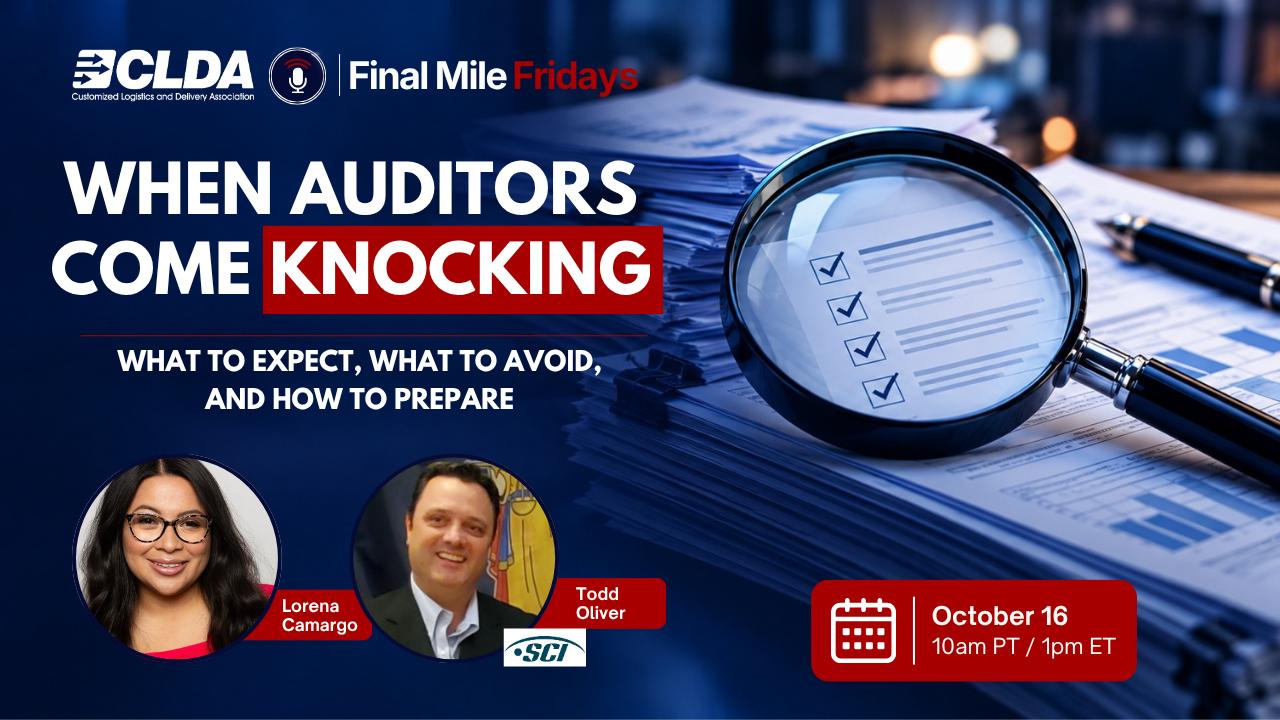
CLDA Final Mile Fridays with Todd Oliver, Director of Government Affairs at SCI
“We’ve always done it this way, and we’ve never had a problem.”
It’s a familiar sentiment among business owners. When processes have worked for years, it’s easy to assume they’ll continue to hold up. But what happens when those practices come under scrutiny?
For final-mile carriers, an audit can raise questions about everything from independent contractor agreements to everyday dispatch practices. And sometimes, the things that seem routine can create unexpected compliance challenges.
During a recent episode of CLDA Final Mile Fridays, CLDA President Lorena Camargo welcomed Todd Oliver, Director of Government Affairs at SCI, for a practical conversation about what triggers audits, what examiners look for, and how carriers can prepare before an issue arises.
The biggest takeaway? Audit readiness isn’t just about having the right paperwork. It’s about how your business actually operates and whether you can demonstrate it.
One common misconception is that audits only happen when a company has done something wrong.
As Oliver explained, that’s not necessarily the case.
Government examinations may come from the IRS, Department of Labor, state unemployment insurance agencies, or workers’ compensation authorities. Businesses may also face scrutiny from insurers, lenders, or legal proceedings.
Some audits are random, but many begin with circumstances such as:
The important question isn’t simply what might trigger an audit, but whether your business is prepared when questions arise.
Having a written independent contractor agreement is important, but auditors don’t stop there.
They examine the actual working relationship, including how delivery opportunities are offered, whether contractors can negotiate pricing, and how much control the carrier exercises over the work.
Oliver emphasized that everyday business records can help demonstrate the independence of those relationships.
That includes delivery contracts, emails, text messages, dispatch records, and documentation showing that contractors operate their own businesses.
What’s written in an agreement should reflect what actually happens in daily operations.
One of the most practical points from the conversation centered on dispatchers and operations managers.
While leadership may understand the distinction between employees and independent contractors, those lines can become blurred in everyday interactions.
Oliver encouraged carriers to train their teams on appropriate terminology and practices. A simple one-page guide can be a useful starting point.
But it’s not just about the words people use. It’s about respecting the independence of the contractor relationship and avoiding unnecessary direction and control over how deliveries are performed.
For companies wondering where to begin, Oliver encouraged a practical approach. Rather than waiting for an audit notice, carriers can start by reviewing their current practices.
Here are five areas worth examining:
The goal isn’t to make compliance unnecessarily complicated. It’s to build processes that support your business and allow you to demonstrate how contractor relationships function.
Oliver’s first piece of advice was simple: Don’t panic.
An audit notice doesn’t automatically mean a company has done something wrong. However, how a carrier responds can make a difference.
He emphasized the importance of working with experienced advisors who understand worker classification and the logistics industry.
Having organized documentation, understanding what information is being requested, and obtaining qualified guidance can help businesses navigate the process.
As Oliver explained, a well-prepared company can demonstrate its business practices rather than scrambling to reconstruct records after an audit begins.
Audit readiness becomes even more important as carriers expand into new markets.
Worker classification requirements and enforcement approaches vary by state, creating additional complexity for businesses operating across multiple jurisdictions.
That’s also why industry advocacy plays such an important role.
During the conversation, Oliver emphasized the importance of having a voice when regulations and enforcement policies affecting final-mile logistics are being developed.
Through its Government Affairs Committee, CLDA works to keep members informed and engaged on issues affecting the industry.
One resource available to CLDA members is the Legislative Tracker, sponsored by SCI, which helps carriers stay informed about proposed legislation and regulatory developments at both the state and federal levels.
For business owners managing daily operations, staying ahead of these changes can make a real difference.
Explore CLDA’s Legislative Tracker →
Staying informed isn’t just about keeping up with legislation. It’s about understanding how potential changes could affect your operations and preparing your business for what’s ahead.
The conversation ended on an encouraging note: strong compliance practices can also support business growth.
Working with established independent businesses, maintaining organized records, and developing consistent operational practices can help strengthen relationships with customers, insurers, and other business partners.
Ultimately, compliance isn’t just about preparing for the possibility of an audit. It’s about building a stronger, more resilient business.
And as Oliver’s insights reinforced, the best time to identify a potential problem isn’t when an auditor is already at your door.
Want to dive deeper? Catch the conversation with Todd Oliver of SCI on CLDA Final Mile Fridays for more insights on audit preparedness, contractor compliance, and protecting your business.
Watch the full episode on YouTube →
To learn more about CLDA and its advocacy resources, visit www.clda.org.
To learn more about SCI, visit www.sciadmin.com.
This article summarizes an educational industry discussion and is not intended as legal advice. Worker classification requirements and audit procedures vary by jurisdiction and circumstances. Carriers should consult qualified advisors regarding their specific obligations.
CLDA Final Mile Fridays with Renee Paul and Alex Dean of SPG Transportation
Growth is usually something to celebrate.
More customers. More drivers. More vehicles. New markets. Bigger opportunities.
But growth has a shadow side that final mile operators don’t always see coming.
Every time your business changes, your risk changes with it.
That was the focus of a recent CLDA Final Mile Fridays conversation featuring Renee Paul, SVP of Last Mile Delivery at Specialty Program Group (SPG Transportation), and Alex Dean. The discussion covered how growth creates new insurance exposures — and why operators who don’t think proactively about coverage can find themselves exposed at exactly the wrong moment.
A company can be growing fast and still be dangerously underinsured. Those two things aren’t mutually exclusive.
Think about the operator who started with 20 trucks under one primary contract. That’s a well-defined, manageable risk profile. Now fast-forward: the same company is running 60 trucks, serving multiple 3PL clients, adding white-glove home delivery and using a mix of W-2 drivers and independent contractors. The revenue has tripled — but the insurance program may still look like it did on day one.
That gap is what Renee calls the “risk shadow” — the space between the company you are today and the coverage you put in place when you were something smaller and simpler. The goal isn’t to slow down growth. It’s to make sure your risk management is keeping pace with it.
One of the most common — and costly — assumptions in this industry is that a coverage limit equals full protection.
Take cargo. An operator looks at the dollar limit on their cargo policy and figures that as long as what they’re hauling is worth less than that number, they’re fine. But commodity type matters. Pharmaceuticals and fine art are examples of cargo that may carry exclusions or require endorsements that a standard policy doesn’t automatically include. Operators moving into new freight categories need to ask the question explicitly — not assume the answer.
Service type matters too. Delivering a package to a doorstep is a different exposure than crossing the threshold into someone’s home to deliver, assemble or install a product. That’s a liability conversation that white-glove operators need to be having with their insurance partners before they sign new contracts — not after a claim surfaces.
Hired and non-owned auto is another area where operators get tripped up. When you’re using independent contractors or vehicles you don’t own, there’s a gap between where the driver’s personal coverage ends and where your company’s exposure begins. Understanding that line — and making sure it’s covered — is critical.
And then there’s contractor compliance — an area Renee is direct about: collecting a certificate of insurance at onboarding is table stakes. The real question is whether that coverage is still in force six months later. Companies that don’t have a process to monitor ongoing compliance are carrying exposure they may not even know about.
Before you take on unfamiliar freight or a new service type, ask: does our current program actually cover what we’re about to do?
Growth doesn’t follow your renewal calendar. You might land your largest customer in June, add vehicles in August and launch a new service in October. Renewal isn’t until February. That’s a long time to operate with a program that no longer fits.
Any of the following should trigger a conversation with your insurance partner — before you move forward, not after:
And if you’re negotiating a new contract, send the insurance requirements to your broker before you sign. They can identify gaps, flag requirements that need to be addressed and sometimes help you push back on terms that go further than the exposure warrants.
The goal is to make that call before you’re committed — not after.
One of the most valuable reframes in the conversation came from Alex: the operators who build the best long-term insurance outcomes aren’t the ones laser-focused on cutting premium. They’re the ones asking a different question.
Instead of: “How do I lower my insurance cost?”
Ask: “How do I improve my risk profile?”
That question opens a very different conversation — one that might include cameras and telematics, MVR monitoring, driver qualification standards, certificate-of-insurance compliance programs and other operational practices that make a company genuinely less risky to insure. Better risk profiles attract better terms. The premium follows.
Your insurance partner should be doing more than processing renewals. They should understand your operation, know where it’s headed and be at the table when you’re evaluating major changes. Think of them the way you’d think of outside legal counsel — someone you bring in before you sign, not after something goes wrong.
Winning customers, adding capacity, entering new markets — that’s the work. Nobody should slow that down.
But the company you’re running today may look very different from the one that signed your current insurance program. And that gap — that risk shadow — is where exposure lives.
So ask yourself honestly: does the insurance program you have today actually match the company you’ve become?
If the answer isn’t a confident yes, it’s time to have that conversation.
Renee Paul and Alex Dean covered a lot of ground in this Final Mile Fridays episode — hidden cargo exposures, hired and non-owned auto, contractor compliance, risk profiling and more. Watch the full conversation on YouTube and see how these issues might apply to your operation.
Watch the full conversation on YouTube →
Have questions about your program? Connect with Renee, Alex and the SPG Transportation team at spgtransportation.com.
The information shared in this article and the accompanying Final Mile Fridays conversation is intended for general educational purposes and should not be considered legal or insurance advice. Companies should consult with their own insurance, legal and risk-management professionals regarding their specific operations.