By Akeem Abodunrin, CEO & Founder, Fusepoint LLC
A shipment can land on time and still miss its customer’s delivery window. The breakdown may happen after arrival: freight is not yet released, the pickup reference is wrong, the vehicle cannot accommodate the load, or the receiving dock has closed. Each team may have completed its own step while the shipment remains stuck between them.
For regional carriers and forwarders, the airport-to-final-mile handoff deserves the same planning as the linehaul. A useful starting point is to make every transfer answer four questions: What is ready? Who has custody? What happens next? Who owns an exception?
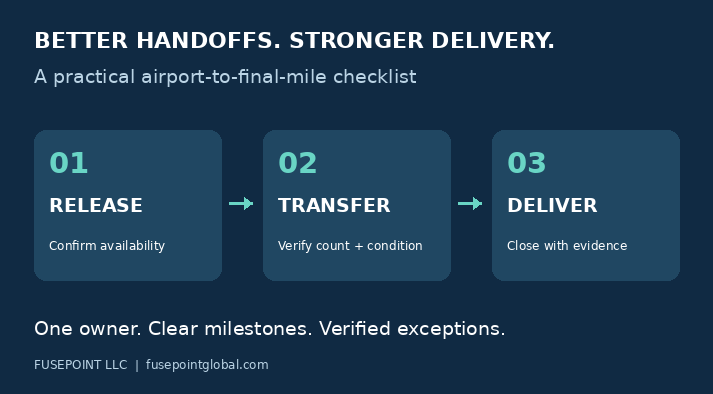
1. Confirm release, not just arrival
A flight arrival is an important milestone, but it does not establish that cargo is available for collection. Before dispatch, confirm the handling location, release status, required pickup references, operating hours and any applicable clearance or payment requirements. Validate driver authorization and facility access requirements with the responsible party rather than assuming that one credential covers every location.
The recovery instruction should be usable without a chain of phone calls. Include the shipment reference, piece count, weight and dimensions, handling needs, pickup contact, delivery appointment and escalation contact. If a critical detail is missing, make that gap visible before a driver leaves.
2. Plan the vehicle and the receiving end together
The right vehicle depends on more than total weight. Check door clearance, loading equipment, pallet configuration, securement needs and delivery-site access. Confirm whether the receiver has a dock, needs a liftgate or requires an appointment. For shipments with special handling requirements, confirm that the assigned equipment and personnel meet the shipper’s documented instructions.
Work backward from the receiving window, allowing time for cargo release, loading and traffic. A dispatch team should know when a delay will make that window unrealistic and who can authorize a different plan. Avoid relying on a driver to recover a planning gap by rushing.
3. Make the custody transfer visible
At pickup, compare the freight with the shipment documents. Record the pieces received and any visible damage or discrepancy before departure, using the handling facility’s process. Where permitted, photos and timestamps provide useful context. Share only the information each party needs and protect confidential shipment details.
A scan or signed receipt should correspond to an actual transfer. When freight passes to a partner carrier or a different driver, record who accepted it, when and where. Those small confirmations help the next team proceed confidently and reduce time spent reconstructing events later.
4. Give exceptions an owner and a next-update time
“Waiting at the airport” is not enough information for a forwarder or consignee to make a decision. A useful exception update states the cause, what is verified, the expected effect on delivery, the available options and the next update time. Identify one person responsible for coordinating the response until the next party explicitly accepts responsibility.
For example, if cargo is unavailable, dispatch can confirm the revised release estimate, check the receiver’s latest acceptance time and present options before the delivery window closes. Keep detention, storage, redelivery and other accessorial approvals clear. An unanswered request is not an approved change.
5. Close the shipment, then learn from the handoff
At delivery, capture the required proof of delivery, recipient details and any exceptions. Reconcile shortages or refused pieces and confirm the next step for undelivered freight. Share closure with the parties who are still planning around that shipment.
For a repeat lane, start with a short weekly review: time from cargo availability to pickup, on-time delivery against the agreed window, exception-response time, proof-of-delivery turnaround and unplanned accessorial costs. Define the milestones consistently before comparing partners. These measures can reveal whether the problem is release readiness, dispatch planning, receiving access or communication.
A regional carrier builds trust by making the whole handoff easier to manage. Clear instructions, realistic timing and verified closure give forwarders a dependable local extension of their operation. That is a practical foundation for repeat business, whether the shipment is crossing a city or connecting to an international supply chain.